'Film Gaming' Might Be the Weirdest New Genre of 2026 — And Its First Platform Is Already Live
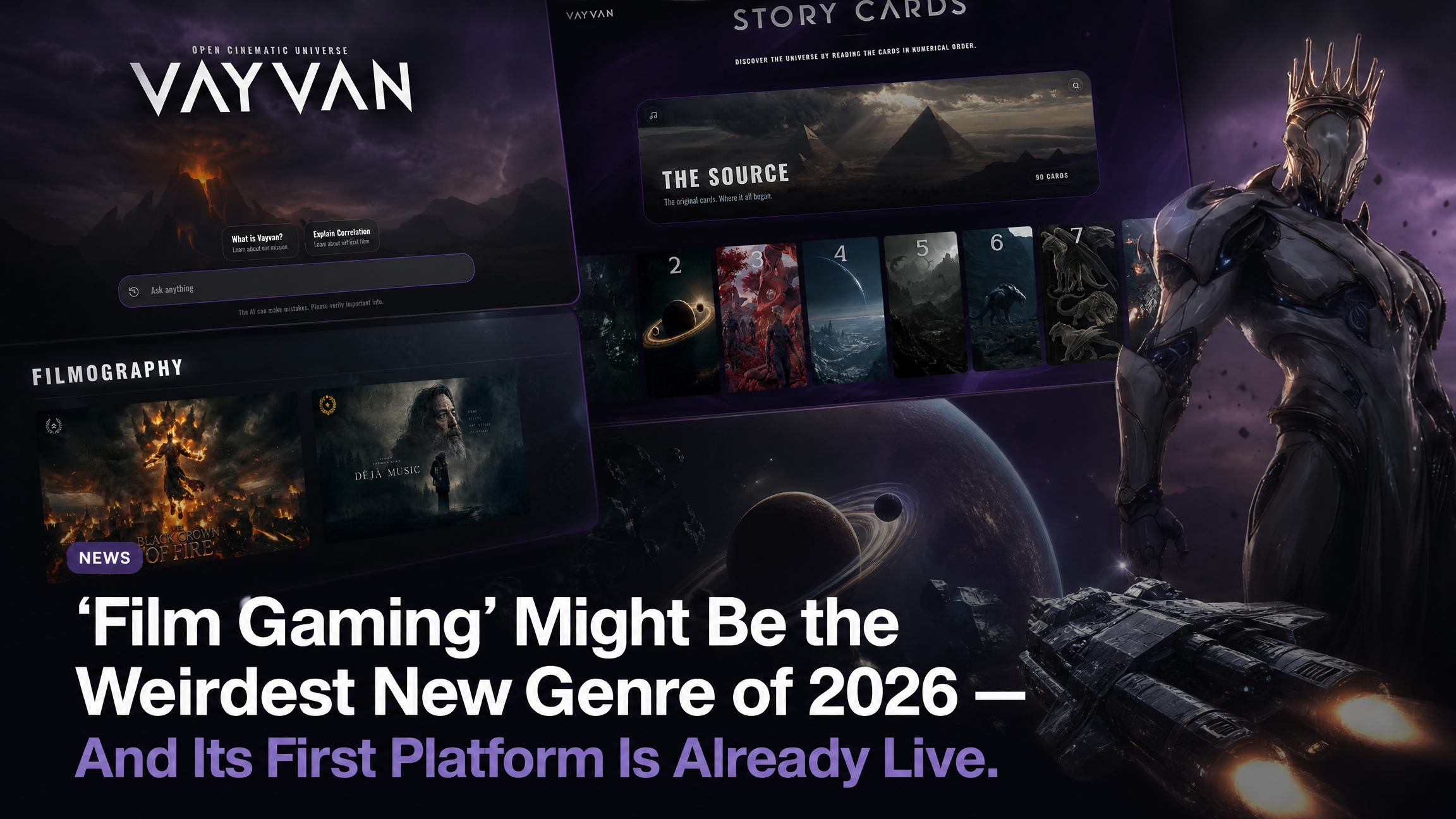
VAYVAN turns filmmaking into a competitive, ranked, XP-driven game — and its breakout release, 'Déjà Music', shows what playing a movie actually looks like.
Every few years, a term shows up that sounds wrong until it suddenly doesn't. "Battle royale" was a niche Japanese movie reference before it became the dominant genre on Earth. "Roguelike" was forum jargon. "Games as a service" was an insult before it was a business model.
The latest candidate: Film Gaming.
The term comes from VAYVAN, an early-access platform that launched quietly in December 2025 and describes itself as the world's first Film Gaming platform — an open cinematic universe where, in its own words, films are how you play.
Here's the pitch, and it's more game than it first sounds: VAYVAN's universe is defined by 90 "Story Cards" — a free, readable canon covering the world's history, characters, and mythology. Creators make films set inside that shared world, tagging the cards their story is built from. Every uploaded film gets ranked — a 0-to-100 score, sorted into five tiers, produced by a combination of algorithmic and human evaluation. And that's where the game layer kicks in: rankings pay out XP to the Story Cards a film was built on, cards level up from 1 to 7, and each level unlocks progressively more prestigious card borders on a creator's profile.
If that loop sounds familiar, it should. It's the structure every ranked game runs on — climb, earn, unlock, flex — except the "match" you're queuing into is a short film, and your MMR is your filmography.
The League of Legends comparison isn't accidental. One persistent world. A shared canon nobody owns but everyone builds in. Mastery levels. Ranked tiers. Seasonal expansion of the universe. VAYVAN is transparently applying the grammar of competitive gaming to a medium that has never had it: cinema.
The first "match" worth watching
Theory is cheap; the platform's recent standout release is the argument. Déjà Music — a short film about a deaf, homeless musician who can hear nothing in this world except music, and who spends decades perfecting the unfinished song that destroyed his life before sending it back through time to undo the accident that silenced him.
It's an AI-made film that doesn't play like one — moody, rain-soaked, emotionally direct — and on VAYVAN it isn't just "content." It's an entry. It got watched by the platform's evaluation panel, scored across lore fidelity, craft, story, and originality, ranked, and slotted into the universe. Somewhere, Story Cards gained XP because it exists.
That's the part that should make gaming people lean in: the film is a move in an ongoing game. Future creators will build on the same cards, chase the same tiers, and compete — not for kills, but for canon.
Why this matters for gaming
Gaming has spent a decade absorbing other media — music (Fortnite concerts), film (The Last of Us going prestige TV), social spaces (Roblox as the new mall). Film Gaming inverts the flow: instead of games borrowing cinema's clothes, it's cinema borrowing gaming's bones — progression, rank, mastery, a persistent world that grows with every player's contribution and, as VAYVAN puts it, never ends.
Whether VAYVAN itself becomes the genre's Fortnite or its forgotten pioneer is an open question — it's early access, the universe currently has more cards than films, and "algorithmic and human ranking" of art will always be contested territory. But the shape of the idea is hard to unsee once you've seen it: a generation raised on ranked ladders and battle passes doesn't just want to watch stories. It wants to climb them.
Exploring VAYVAN is free — the 90 Story Cards, the films, all of it. Uploading a film is how you enter the game. And somewhere out there, someone is about to grind cinema like it's ranked solo queue. Honestly? We get it.